

Lecture 1: How to Read Great Churches
Cathedrals, abbeys, priories, even grand parish churches comprise many of our greatest ancient buildings. But how can we read them… were they designed according to a ‘sacred geometry’? How does their location communicate to us? Why are the buildings different shapes? What can sculpted details tell us? And what were the influences of the dedicatory saints? This talk distils the experience behind six books on great churches to explain some principles behind the concept and construction of great churches, that can be applied wherever you look.
Lecture 2: A Paradise Garden: the Hidden Meanings of Medieval Flowers
Have you noticed how many medieval paintings are set in May? The language of plants evolved over the centuries to create a lexicon of creation that paved the way to Paradise, a perennial early summer where all the flowers and all the fruits emerge at the same time- but each tells us something different. We explore paintings, tapestry, manuscripts and sculpture to re-learn a lost language.
Lecture 3: The Nature of the Beast: Lessons from Medieval Animals
Animals were central to medieval arts: we find birds, reptiles, mammals, insects and fabulous creatures in sculpture, illuminated manuscripts, paintings, tapestries and even wax seals. But what were the artists trying to tell us through the animals they portrayed? This talk explores a lost artistic language, to discover that the behaviours and legends of creatures enabled us to learn about ourselves.
About our Speaker:
Dr Jonathan Foyle is a career communicator, best known for presenting TV series such as BBC2's Broadcast Award-winning 15-part 'Climbing Great Buildings', as well as contributing to Channel 4's 'Time Team' and Channel 5's 'Secrets of the Royal Palaces'. His former roles have encompassed Curator at Hampton Court and Chief Executive of World Monuments Fund Britain, writer for the FT Weekend, and he is now a lecturer at the University of Bath. Jonathan has authored seven volumes on great cathedrals and castles and has spoken across the world about discoveries in British arts. The offered Arts Society talks offer fresh and original analyses of personal fascinations in architecture and the arts and crafts, especially their all-important symbolism, through which we can better understand what their makers were trying to communicate- to anyone who holds the keys to deciphering. The aim of these talks is to share those keys, in friendship and with a sense of humour.
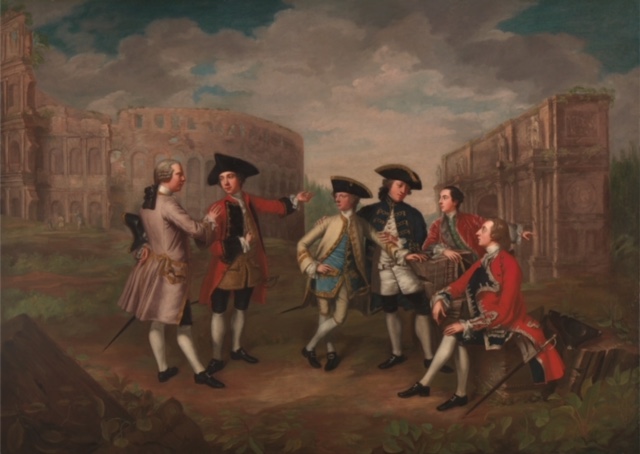
The Grand Tour
Beginning in the seventeenth century, and reaching a peak of popularity during the eighteenth, the Grand Tour was the practice whereby many wealthy young Britons visited continental Europe, Italy in particular, as an important part of their cultural education. It was a path followed also by many British artists and architects, including Joshua Reynolds, Richard Wilson and Robert Adam. What did these journeys entail? What were these travellers looking for? What was the impact of what they found – and, in many cases, brought back – on art, architecture, and design in Britain?
Grand Tour Portraiture
Beginning in the seventeenth century, and reaching a peak of popularity during the eighteenth, the Grand Tour was the practice whereby many wealthy young Britons visited continental Europe, Italy in particular, as an important part of their cultural education. Popular souvenirs included portraits of the travellers commissioned from Italian artists, such as Rosalba Carriera and Pompeo Batoni, or from British painters living in or visiting Italy. We will look at a variety of such works, considering what the Grand Tourists were looking for and the influence of these paintings on art back in Britain.
About the Lecturer
Prasannajit de Silva completed his doctorate in 2007, researching the art of the British in India during the late eighteenth and early nineteenth centuries. His lecturing covers British visual culture of the eighteenth, nineteenth, and early twentieth centuries, including art produced in various colonial settings. He is particularly interested in the relationship of aspects of art, architecture, and design to their broader cultural, social, and political contexts, and also teaches courses on the methods and theoretical approaches of art history. His work has included teaching roles at the University of Sussex, at Birkbeck, University of London, and at the WEA. His publications include Colonial Self-Fashioning in British India, c1785-1845: Visualising Identity and Difference (2018).
Use the Bookwhen link below to book (otherwise for BACs/Cheque/Cash payments please use this form HERE )